
Jefferson County Projected and Actual Dates
A projected release date, often shortened to PRD, is an estimate computed for a sentenced ODOC prisoner. It is not the time a jail door will open. Oklahoma's Pardon and Parole Board defines PRD as ODOC's estimate and stresses that credits, programs, and misconduct may move it. Parole eligibility is another date. It marks when consideration may occur, not when release will happen. The actual release follows legal approval, sentence administration, any hold checks, and physical processing.
A sentence-completion date can differ from a parole date as well. Parole places a person in the community for the balance of confinement under conditions, while discharge marks the formal end of the sentence or supervision. A transfer date means only that one custodian handed the person to another. These labels answer different questions and should be copied exactly from the source record.
Jefferson County pretrial detainees usually do not have a computed prison PRD. Their custody may end after bond conditions are met, a case is dismissed, a judge enters an order, or another legal event occurs. Even then, another warrant or agency hold can prevent community release. County jail staff and the court are the right sources for that timeline. ODOC is the right source after a state sentence and reception.
Find a Jefferson County Projected Release Date
Start by identifying who holds the person and why. The Jefferson County Jail record, Jefferson County court docket, and ODOC record answer different questions. A person sentenced to ODOC may wait in the county jail before reception, so a court judgment can exist before the state profile reflects the move. Match the name with date of birth, case, county, ODOC number, photo, aliases, and offense where available.
- For a county booking, call Jefferson County Jail at 580-228-2375 and ask whether the person is pretrial, serving a county term, awaiting transfer, or subject to another hold.
- Search OSCN for the Jefferson County case. Read bond, judgment, sentence, amended orders, revocation, dismissal, and warrant entries.
- For a state sentence, search ODOC Offender Lookup by exact and variant name or ODOC number. Use only date fields and labels actually shown.
- If the date is confidential or absent, ask the person for the monthly days-remaining information ODOC provides, or use the official records route when authorized.
- Confirm the actual release with the jail or ODOC after the estimated date. If the person left county custody by transfer, continue with the receiving system.
The broader Jefferson County released inmate records path explains how county, court, ODOC, VINE, federal, and immigration records fit together.
ODOC Jefferson County Date Limits
ODOC's public guidance creates an important limit. It says an inmate's actual release date is confidential unless the requester can show a legitimate need, such as a judicial or law-enforcement need. ODOC gives the inmate a monthly count of days remaining, and the inmate can share that information. The agency calls the date tentative because credit level, achievement credits, and misconduct may change it.
The official ODOC Offender Info page is the source for this distinction.
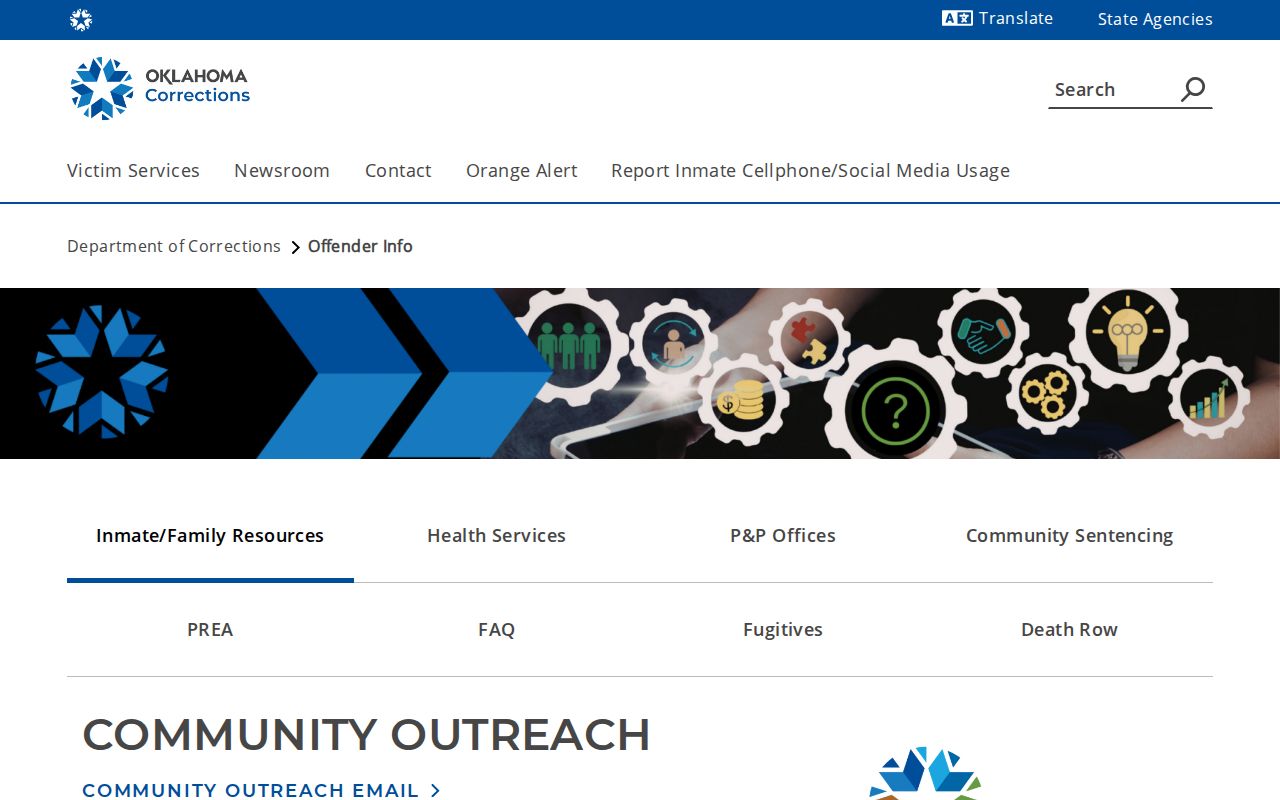
The screen supports a careful lookup: explain the estimate and its drivers, but do not promise that an exact date is public for every state prisoner.
Victims with a release concern can contact ODOC Victim Services at 405-425-2607 or victim.services@doc.ok.gov. That route is distinct from a general public search. Sentence Administration and Offender Records hold authority for formal state time calculations and discharge questions.
For a former prisoner, the public lookup may show inactive, discharged, parole, or another status. Read it beside the sentence and supervision history. Probation can stem from a suspended or deferred sentence and does not prove that the person served a prison term. When the screen is ambiguous, ODOC lists Closed Records at 405-425-2691 and osordischarges@doc.ok.gov for discharge inquiries. A specific records request is more useful than asking for a broad file.
Jefferson County Earned-Credit Rules
For an ODOC sentence, Oklahoma's earned-credit law is 57 O.S. § 138. The standard monthly deductions are zero credits in Class 1, 22 in Class 2, 33 in Class 3, and 44 in Class 4. Achievement credits can also affect the calculation. Misconduct or failure to perform can cause credit loss. Restoration may be authorized in some circumstances, but it is not automatic.
The statute screen shows the legal credit schedule used in state sentence work.
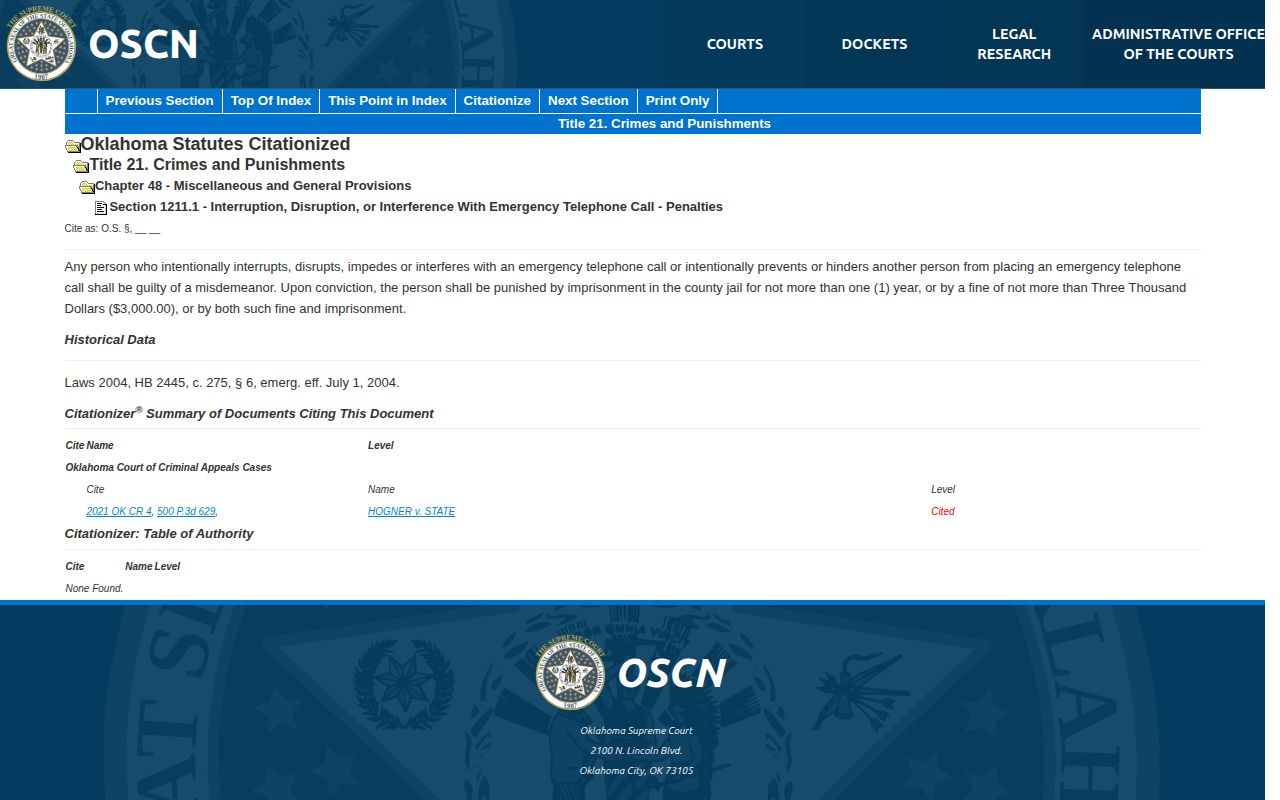
These credits are inputs, not a stand-alone calculator. ODOC's Sentence Administration policy says accurate dates can require current and historical credit systems, sentence order, jail credit, and later corrections. The departmental authority, not a home calculation, resolves the official date.
A county-jail sentence does not automatically use the ODOC class worksheet. Ask Jefferson County Jail and the court what credit authority applies to that sentence. A person awaiting trial has no sentence-based credit projection at all. Those differences prevent a state rule from being applied to the wrong custody type.
Additional jail credit, amended orders, and the order in which sentences run can affect the state total. A consecutive sentence begins in sequence, while a concurrent sentence may run at the same time as another term, as the judgment directs. The public docket can reveal an amended judgment, but only ODOC can state how it was applied to the official calculation.
Jefferson County Eighty-Five Percent Sentences
Certain offenses listed in 21 O.S. § 13.1 require at least 85 percent of the imposed term before parole eligibility. Earned credits cannot reduce confinement below that statutory floor. The rule does not apply to every offense described in casual speech as violent. Check the exact listed offense and the statutory version tied to its date.
The official statute view identifies the enumerated-offense framework.
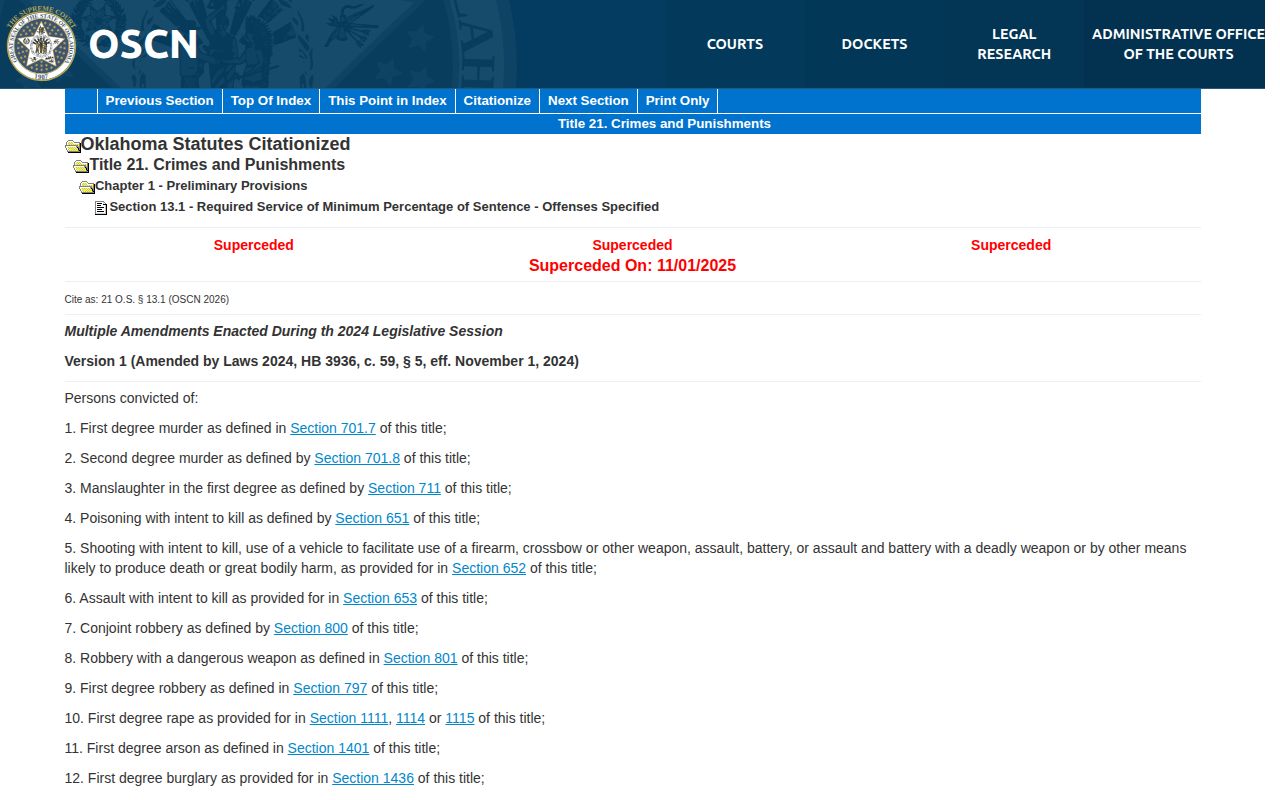
This floor affects parole eligibility and credit limits. It still does not turn the Board hearing date into an actual release date.
Eligibility under 57 O.S. § 332.7 also changes by offense and date. Some categories do not fit a simple one-third formula. Death, life without parole, mandatory terms, short-to-discharge cases, sanctions, and other exclusions require the judgment and current law. The safe reading is specific to the person and sentence.
Why Jefferson County Release Dates Move
A PRD may move earlier or later. Some changes arise from conduct and programming, while others come from courts or another agency. The date can also change when officials correct a record. None of these changes should be inferred from a missing roster name.
| Factor | Possible effect | Best source |
|---|---|---|
| Class or achievement credits | May reduce time within statutory limits | ODOC sentence calculation |
| Misconduct or nonperformance | May remove credits and move the PRD later | ODOC record and inmate statement |
| Amended order or added jail credit | May change the sentence start or credit | Court order and ODOC administration |
| Consecutive terms or rebill | May change sequence and remaining time | ODOC Sentence Administration |
| Detainer or agency hold | May prevent community release at sentence end | Custodian and receiving agency |
| Parole action or commutation | May alter the release route after final action | PPB, Governor where required, and ODOC |
Note: A transfer ends one custody entry but does not prove that the person returned to the community.
How ODOC Calculates Jefferson County PRDs
ODOC labels the estimate Projected Release Date, yet its worksheet separates projections by class and custody setting and excludes restricted-earned-credit sentences. That is the distinctive Oklahoma calculation issue. A general online calculator cannot account for every historical rule, restriction, sentence sequence, misconduct entry, detainer, commutation, escape and return, or administrative correction.
Sentence Administration policy OP-060211, effective April 7, 2026, assigns final departmental authority over time calculations and release dates to the Manager of Sentence Administration, Offender Records, and Registries. When two public entries conflict, request review through that ODOC channel. Include the judgment, ODOC number, relevant jail-credit order, and the exact fields in dispute.
Keep a dated copy of each source used in the inquiry. Portal labels and records can change after a calculation is corrected. A dated court order, ODOC response, and jail disposition let the responsible office see the conflict. They also show whether the dispute concerns an estimate, credit award, parole stage, transfer, or actual release. That focused question is easier to resolve than a request asking only when someone gets out.
For a Jefferson County sentence that never entered ODOC, request the jail's calculation and the court authority it follows. For a state sentence awaiting reception, preserve the county booking record and judgment, then compare them with the eventual ODOC reception entry. This creates a traceable chain.
Confirm a Jefferson County Release Date
Near an expected date, check the correct custodian again. Jefferson County Jail can confirm whether a county detainee left custody and whether the disposition was community release or transfer. ODOC can confirm state status within its public and confidential-record limits. A court order explains authority but may precede physical processing. Keep the recorded release date and destination with the case information.
Ask a narrow question when calling the jail: did Jefferson County custody end, at what recorded date and time, and what destination or disposition was entered? If staff can confirm only present custody, request the existing jail-register and release entry. The absence of a name from a current list cannot supply a missing date, reason, or receiving agency.
OK VINE can provide an agency-fed custody event for a specifically matched person. Register before the event when possible, and read transfer, release, escape, apprehension, or death literally. The Jefferson County VINELink release check describes the one-person search and notification steps. VINE is corroboration, not a permanent release ledger.
If an expected release does not occur, ask whether credits changed, an amended order arrived, another sentence remains, or a detainer controls the next destination. A clear answer names both the date and the legal or agency event behind it.
Public Record Search
Sponsored Results